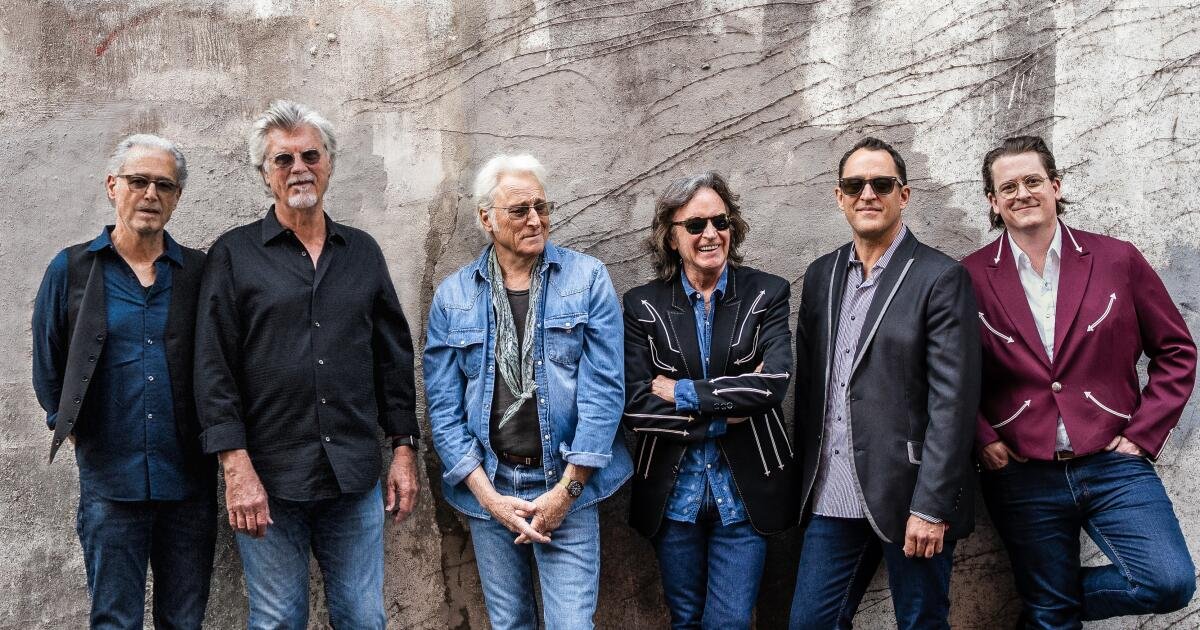
Jeff Hanna, Nitty Gritty Dirt Band founder and de facto leader, is tucked into a nondescript booth at El Palenque, a 30-years-plus local restaurant in a Nashville strip mall, talking about “Nashville Skyline,” a pensive track from their EP, “Night After Night.” The family-owned Mexican restaurant is the kind of place he’s gravitated toward since starting a jug band with friends in Long Beach before migrating to Los Angeles’ folk/rock scene.
Threaded with fiddle, piano and lead vocal by his son Jaime, “Nashville Skyline” is an elegy for Nashville’s rapacious gentrification as well as a love lost to time. The metaphor isn’t lost on the elder Hanna, who recognizes what’s been lost with a dignity and sweetness.
“It’s more reflective,” he allows. “But [capturing moments is] what we do best.”
For the dark-haired 78-year-old, this scene’s played out countless times across a career that’s spanned a number of genres related to folk, pop and country: meeting a journalist to talk about the band’s singular brand of American music. Yet little about the NGDB’s sound has changed across six decades.
Beyond “Mr. Bojangles,” written by Jerry Jeff Walker, and “The House at Pooh Corner,” written by Kenny Loggins, the regulars of the Troudadour/Ash Grove clubs would have pop success as the ‘70s became the ‘80s with “Make a Little Magic,” featuring Nicolette Larson, and “Viola! An American Dream,” with vocals from Linda Ronstadt. But it was the multi-generational and genre-bridging Grammy-nominated “Will the Circle Be Unbroken,” recorded with Nashville royalty Roy Acuff, Maybelle Carter and Earl Scruggs among many others, that grounded the band’s future as a mainstream country act in the ‘80s and ‘90s, as well as what’s become Americana.
“Will the Circle Be Unbroken, Vol. 2” (1989) and “Will the Circle Be Unbroken, Vol. 3” (2004) continued that trend. Both brought home Grammys, while featuring Rosanne Cash and John Hiatt, Johnny Cash, Willie Nelson and Tom Petty, Randy Scruggs, John Prine, Bruce Hornsby, Dwight Yoakam and Hanna’s son Jaime. Also, a wunderkind dobro player named Jerry Douglas.
Hanna talks animatedly about Douglas’ production on their five-song EP: “Like a lot of guys who came up in the second wave of bluegrass after Bill Monroe, Flatt & Scruggs, the Stanley Brothers, Jerry’s part of a progressive musical heritage with New Grass Revival, Tony Rice and New South where genre- and cultural-crossing makes you super open-minded, so what we do is very fluid for him.”
The Grammy-winning dobro icon/master — Douglas receives name-billing as part of Alison Krauss & Union Station — has history with the Dirt Band. Beyond playing on “Long Hard Road,” their first country No. 1, Douglas has loved their music since “seeing them in Mole Lake, Wisconsin, at a festival on an Indian Reservation.”
“It was 1973, I was 19 and playing with the Country Gentlemen. Everybody was smoking; there was even a paraquat-testing booth. The Vietnam War was happening. But ‘Will the Circle Be Unbroken’ was out; they had Vassar Clements playing with them — and the honesty of their music stuck out.”
That honesty and being in the moment carried the Dirt Band across cultural upheavals, changing technology and tastes by allowing songs and their sheer joy of playing to define a career marked by over 100 shows a year, scattered recorded projects that featured songs by Marshall Crenshaw, Steve Goodman, Bruce Springsteen and 2022’s “Dirt Does Dylan.”
“I feel really good about ‘Night After Night ‘as a moment in time,” Hanna says. “It’s a good combination of what we do, where we are. It’s a little reflective, but I love the way the songs flow together … and as much as I wanted to be (Don) Henley in ’75, I made my peace with that for something that’s truer.”
Truer means blending founder Jimmie Fadden (drummer/writer/harmonica), 40-years-plus member Bob Carpenter (keyboards/vocals) and longtime pal Jim Photoglo (bass/vocals) with stand-out next-gen players multi-instrumentalist Ross Holmes (Mumford + Sons, Bruce Hornsby) and Hanna’s son, guitarist/vocalist Jaime (the Mavericks, Gary Allen). Hanna says, “Jaime’s one of my best friends in the world and we share a lot of music, but his chops are substantial. I sometimes look over, hearing him play what were my solos and smile. He’s got the three T’s in electric guitar: tone, taste and timing.”
Beyond the EP’s romping Paul Kennerly/Daniel Tashian title track ruminating on love lost’s impact, a poignant sense of reckoning with the passage of time and loss of places that matter is tempered with grace and acceptance. Featuring prominent acoustic guitar picking, Fadden’s signature harmonica and lyrics stained with philosophical nostalgia, the project gilds the band’s current Farewell Tour celebrating 60 years of music-making that rooted when “Buy for Me the Rain” became a regional Los Angeles hit.
Douglas concurs about the fingers-on-strings magic. “We recorded all this at Oceanway, sitting in a circle, running the songs and looking at each other. It’s a little more organic than some projects; we didn’t do 20 takes, but created dynamics … I’ve played music my whole life, and this was one endorphin rush after another.”
That rush can’t be machined or algorithmed. Both Country Music Hall of Fame Chief Executive Kyle Young and Americana Music Assn. Executive Director Jed Hilly point to the Dirt Band as a groundbreaking influence.
Young enthuses, “I grew up in Nashville, and it took them to show me Nashville’s musical history and heritage; I was listening to everything but country. That first ‘Circle,’ you can’t overemphasize its impact enough,” while Hilly raves, “They were legendary when I was 10 years old in Vermont, going to the Craftsberry Fiddle and Banjo Contest! It was Neil Young’s ‘Harvest,’ [Grateful Dead’s ‘Working Man’s Dead,’ Doc Watson and ‘Circle.’]”
Hilly continues, “I’ve heard T Bone Burnett talk about ‘Oh Brother,’ how great music cuts through. But the Dirt Band? They were pivotal, like John Prine, who just made his music … reaching into the past, but bringing it to the present so it’s very current. And the happiness onstage? No one’s like them.”

And there’s Darius Rucker, a contemporary country star and leader of ubiquitous ‘90s rock/roots Hootie & the Blowfish, who emailed, “I learned so much about the true roots of country and how to apply it when we started making records in college.
“They were a great pop band, and ‘Circle’ was such an important moment for bringing old-school country and bluegrass artists — Maybelle Carter, Roy Acuff, Doc Watson, and Merle Travis — into the room with ‘hippie kids’ … It allowed for country and California rock to come together. “
Laughing when the praise is shared, Hanna demurs. “The amount of eye rolls you get from saying ‘Farewell Tour,’ because it’s so abused. But the rigors of touring, especially with travel the way it is … Fadden’s always been one to remind us how grateful we are when it’s three hours of sleep, the food choices aren’t so good and something’s lost, because we are.
“We’ve never stopped making music,” Hanna continues. “Sometimes we were the Toot Uncommons with Steve Martin, or playing as Linda Ronstadt’s back-up band for a minute, but it was always great music. Even when record company people would suggest something to make us ‘cool with the kids,’ we knew, and don’t have too many cringe moments.
“With ‘Night After Night,’ I got to co-write most of this record with my son, my wife (Nashville Songwriter Hall of Famer Matraca Berg) and friends like Mac McAnally. Jaime brought us some cool songs, too. Everybody played great. We had the same kind of fun we did when we started. Sixty years in, what more is there?”